
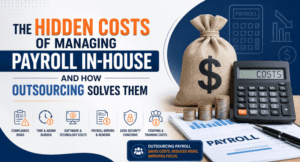
Payroll is one of the most critical functions within any organization. Employees expect accurate and timely salary payments, while businesses must comply with tax regulations, labor laws, and statutory requirements. Many companies, especially small and medium-sized businesses, initially choose to manage payroll internally to maintain control and reduce expenses. However, what appears to be a cost-saving decision often comes with hidden expenses that can significantly impact business efficiency and profitability.
Understanding these hidden costs is essential for organizations looking to streamline operations and focus on growth.
1. Time-Consuming Administrative Tasks
Managing payroll in-house involves much more than simply calculating salaries. HR and finance teams must track attendance, calculate overtime, process deductions, manage reimbursements, generate payslips, and ensure timely salary disbursement.
As employee numbers grow, payroll complexity increases. Valuable time that could be spent on strategic HR initiatives, employee engagement, or business development is instead consumed by repetitive administrative tasks. This loss of productivity often represents a significant hidden cost.
How Outsourcing Helps:
Payroll outsourcing providers automate payroll processes, reducing manual effort and allowing internal teams to focus on core business activities.
2. Compliance Risks and Penalties
Employment laws, tax regulations, provident fund contributions, professional tax requirements, and other statutory obligations frequently change. Keeping up with these updates requires constant monitoring and expertise.
Even minor errors in tax calculations, late filings, or incorrect statutory deductions can result in penalties, legal complications, and reputational damage. For many businesses, compliance-related mistakes become costly and difficult to rectify.
How Outsourcing Helps:
Professional payroll service providers stay updated with the latest regulations and ensure accurate compliance, minimizing the risk of penalties and legal issues.
3. Software and Technology Costs
Modern payroll management requires specialized software to process salaries, maintain records, generate reports, and ensure data security. Purchasing, implementing, upgrading, and maintaining payroll software can be expensive.
Additionally, businesses may need IT support, data backups, cybersecurity measures, and software training for employees.
How Outsourcing Helps:
Payroll outsourcing providers use advanced payroll technology as part of their service, eliminating the need for businesses to invest heavily in software infrastructure.
4. Payroll Errors and Rework
Manual payroll processing increases the likelihood of errors. Incorrect salary calculations, missed deductions, inaccurate tax filings, or delayed payments can lead to employee dissatisfaction and additional administrative work.
Correcting payroll mistakes often requires significant time and resources. Repeated errors can also damage employee trust and negatively affect workplace morale.
How Outsourcing Helps:
Experienced payroll professionals use automated systems and quality control processes to ensure higher accuracy and reduce costly payroll mistakes.
5. Data Security Concerns
Payroll data contains highly sensitive employee information, including bank account details, tax records, compensation structures, and personal identification information.
Managing this data internally exposes organizations to risks such as unauthorized access, data breaches, and accidental information leaks. A single security incident can result in financial losses and reputational damage.
How Outsourcing Helps:
Reputable payroll providers implement advanced security protocols, encryption technologies, and secure data management practices to protect confidential information.
6. Employee Training and Staffing Costs
Businesses handling payroll internally must hire qualified payroll professionals or train existing staff. Recruitment, onboarding, continuous training, and employee turnover all contribute to rising operational costs.
When key payroll personnel leave the organization, payroll continuity can become a challenge.
How Outsourcing Helps:
Outsourcing removes the need for specialized payroll staffing, ensuring uninterrupted payroll processing without recruitment or training expenses.
7. Limited Scalability
As organizations expand into new locations, hire more employees, or adopt hybrid and remote work models, payroll requirements become increasingly complex. Internal payroll systems may struggle to scale efficiently.
This often leads to increased costs, process inefficiencies, and additional administrative burdens.
How Outsourcing Helps:
Payroll outsourcing providers offer scalable solutions that adapt to changing workforce requirements, supporting business growth without increasing operational complexity.
Conclusion
While managing payroll in-house may seem economical at first, the hidden costs associated with administrative workload, compliance risks, software investments, payroll errors, security concerns, and staffing requirements can quickly add up. These challenges not only increase expenses but also divert attention from strategic business priorities.
Payroll outsourcing offers a practical and cost-effective solution by improving accuracy, ensuring compliance, enhancing data security, and reducing administrative burdens. By partnering with a reliable payroll service provider, businesses can focus on growth, employee satisfaction, and long-term success while leaving payroll complexities to the experts.